
Indian Auto Component Industry grows 6.8% in H1 FY26
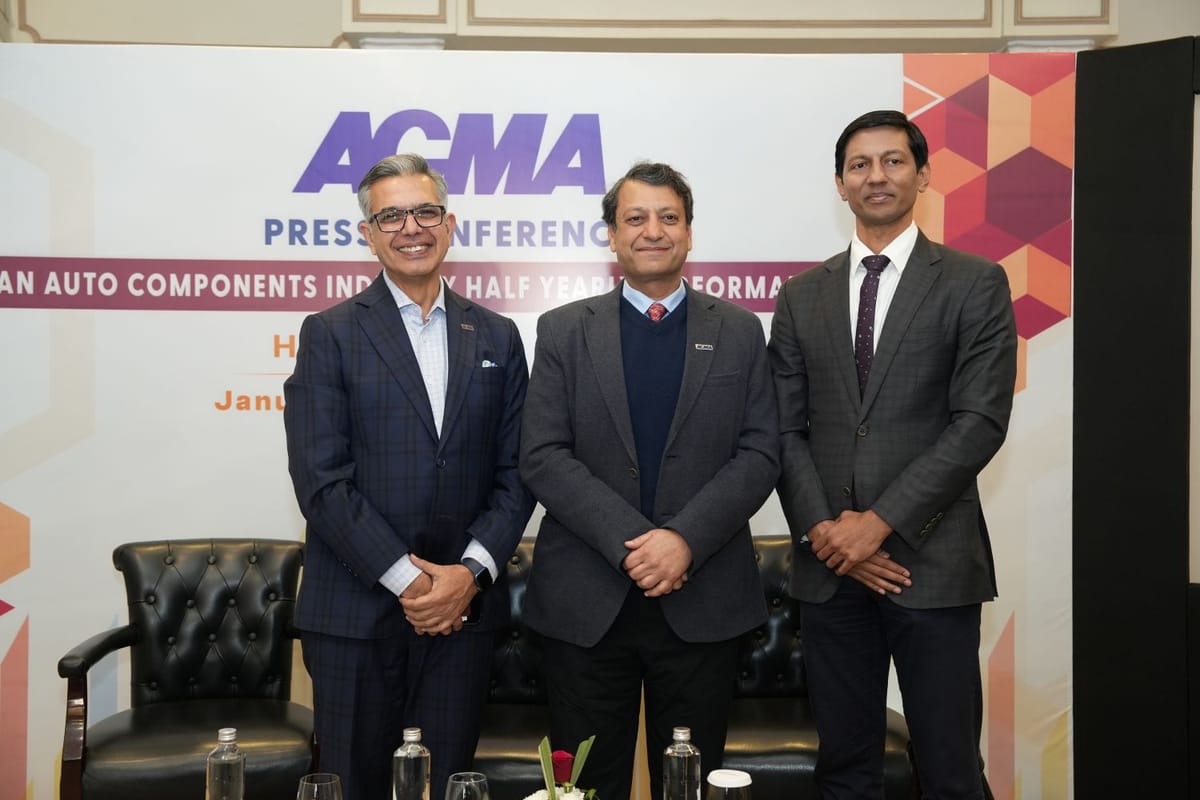
The Automotive Component Manufacturers Association of India (ACMA), the apex body of the auto components industry, announced the findings of its Industry Performance Review for the first-half of FY 2025-26 (April–September 2025). The Indian auto component industry grew by 6.8 per cent to Rs. 3.56 lakh crore (USD 41.2 billion) in H1 FY26 compared to the same period last year, supported by stable domestic demand, a resilient aftermarket, and continued investments in capacity expansion, localisation and technology upgradation.
Sales to OEMs rose by 7.3 per cent to Rs. 3.04 lakh crore (USD 35.2 billion) during the period, led primarily by the passenger vehicle and LCV segments. The aftermarket recorded a robust growth of 9 percent clocking Rs. 53,160 crore (USD 6.1 billion), driven by an expanding vehicle parc, increasing formalisation of the repair and maintenance ecosystem, and deeper penetration of organised channels.
On the external trade front, exports of auto components grew by 9.3 per cent to USD 12.1 billion, while imports increased by around 12.5 per cent to USD 12.3 billion, resulting in a trade deficit of USD 180 million, compared to a surplus of USD 150 million in H1 FY25. It is important to note that this export growth was achieved despite significant global headwinds, including supply-chain disruptions, raw material cost pressures, and weakening aggregate demand in key markets. The United States and Germany remained among the top export destinations, while China, Japan and Germany continued to be the leading sources of imports.
Electric vehicles accounted for 4.6 per cent of total supplies to OEMs, underscoring the steady transition towards new-age mobility.
Sharing his insights on the performance of the auto components sector, Vinnie Mehta, Director General, ACMA, said, “H1 FY26 performance reflects the underlying strength of India’s automotive ecosystem, with growth across OEM supplies and the aftermarket. On the trade side, export growth has remained healthy, though imports have risen at a faster pace, leading to a marginal trade deficit. The industry is responding through deeper localisation, capacity expansion and closer collaboration with stakeholders, while preparing for the next phase of growth driven by new mobility technologies.”
Commenting on dynamics of the industry, Sriram Viji, President-Designate, ACMA and Managing Director, Brakes India Pvt Ltd., mentioned, “While domestic demand remains broadly stable, the operating environment continues to be shaped by geopolitical uncertainties, supply-chain disruptions and cost pressures. Addressing challenges such as the availability of critical materials, including rare-earth magnets, and enhancing supply-chain resilience will be critical for sustaining long-term growth.”
Elaborating on the mood of the industry and outlook for the near to mid-term future, Vikrampati Singhania, President ACMA and Managing Director, J K Fenner (India) Ltd. added, “While demand conditions in the first half were driven largely by underlying domestic fundamentals, the second half of the fiscal is expected to benefit from improving retail sentiment, supported by recent policy measures, seasonal demand and continued infrastructure-led activity.”
The reduction in GST on select vehicle categories, effective post-September, is expected to support demand momentum in the second half of FY26, particularly in passenger vehicles and two-wheelers, with potential positive spillovers for the component ecosystem. In addition, sustained performance in tractors and a gradual recovery in commercial vehicles could further strengthen demand as utilisation levels improve.
At the same time, the industry continues to face key headwinds including geopolitical uncertainties, rising freight costs, raw-material price volatility, high GST rates on auto components, and the limited availability of critical materials such as rare-earth magnets.