
India’s LPG Crisis
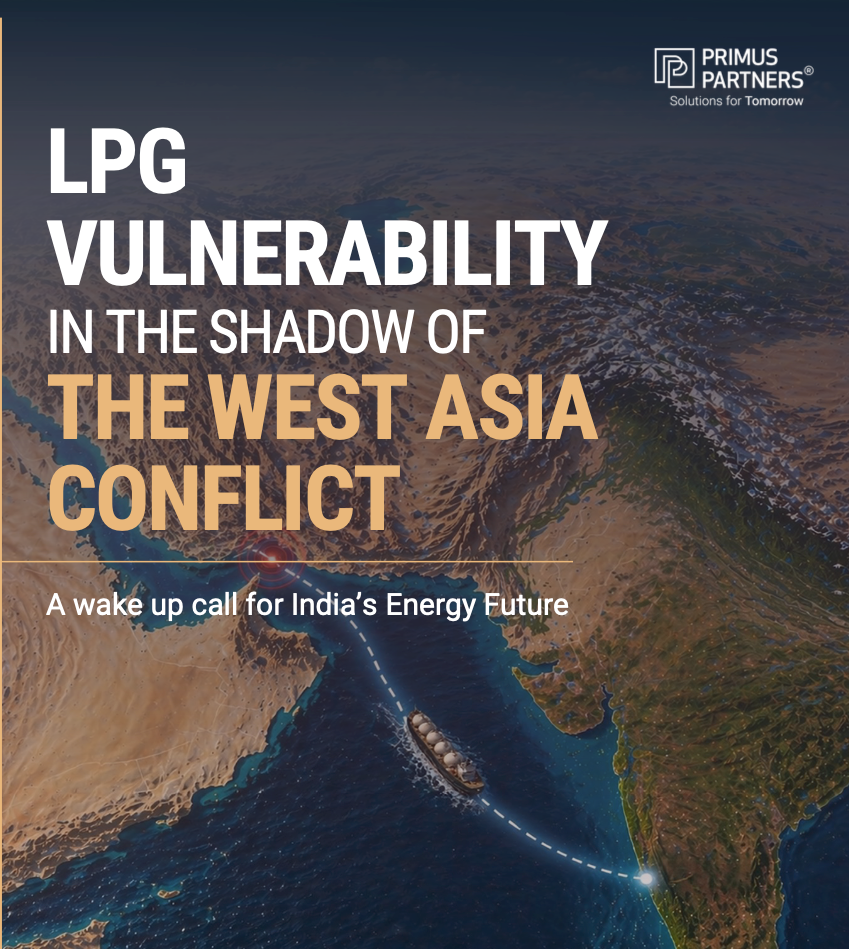
Primus Partners has launched its latest thought leadership report, 'LPG Vulnerability in the Shadow of the West Asia Conflict: A Wake Up Call for India’s Energy Future', examining how the ongoing geopolitical tensions have exposed India’s structural dependence on imported LPG. The report highlights key risks, including supply concentration through the Strait of Hormuz, limited storage capacity, and the wider economic impact on households, MSMEs, and industry.
It further outlines a strategic roadmap for India’s long-term energy resilience through the diversification of energy sources, accelerated PNG adoption, scaling up biogas potential, and strengthening storage and infrastructure capabilities. The report also emphasises the need for a balanced and self-reliant energy mix aligned with Viksit Bharat 2047.
The ongoing LPG disruption linked to tensions in West Asia has brought renewed attention to India’s energy security, with emerging analysis indicating that the situation reflects deeper structural gaps rather than a short-term supply challenge.
India’s rapid expansion of LPG access over the past decade has been a major success. However, this growth has not been matched by equivalent progress in supply diversification, buffer storage capacity, or alternative fuel readiness, leaving the system exposed during supply chain disruptions.
The recent events point to a larger need to move beyond supply-side fixes and build a resilient system. This requires not just diversifying import sources, but also strengthening domestic alternatives and energy infrastructure that can absorb shocks.
Domestic alternatives such as biogas represent an important but underutilised opportunity. With India generating large volumes of agricultural and municipal waste, biogas can meaningfully offset LPG demand. At the same time, India must accelerate the development of firm, dispatchable renewable energy systems by integrating it with long-duration storage solutions, enabling reliable round-the-clock power for the end users.
Davinder Sandhu, Co-Founder & Chairman, Primus Partners, said, “India’s LPG disruption is not just a supply issue, it is a signal to strengthen the structural resilience of our energy system. The focus must shift from fuel substitution alone to building integrated energy systems, combining domestic solutions like biogas, robust natural gas infrastructure and storage-backed renewable energy, to ensure reliable, round-the-clock supply and reduce import dependence. A diversified energy mix, backed by strong infrastructure and energy efficiency, will be critical to ensuring long-term stability and security.”
Parallel investments in gas pipelines and last-mile connectivity will further support a gradual shift toward alternative fuels such as piped natural gas, ensuring that households and businesses have access to multiple energy options.
Subhash Kumar, Former CMD & Director (Finance), ONGC, said, “The current situation highlights the importance of building depth and flexibility into India’s energy architecture. Strengthening buffer storage by utilising stranded national assets, expanding connectivity and focusing on homegrown energy solutions and will be key to enhancing resilience. India’s long-term pathway lies in a balanced, multi-source energy strategy that reduces vulnerability to external disruptions while supporting sustainable growth and ensuring that India’s energy transition remains stable, flexible and secure over the long term”
The broader takeaway is clear. As India advances its energy transition, strengthening domestic alternatives like biogas and building robust storage-backed renewable systems with distributed infrastructure will be critical to creating an energy system that is both resilient and future-ready.
Full report here: