
Public health crises book 'Perils of Health Infodemic'
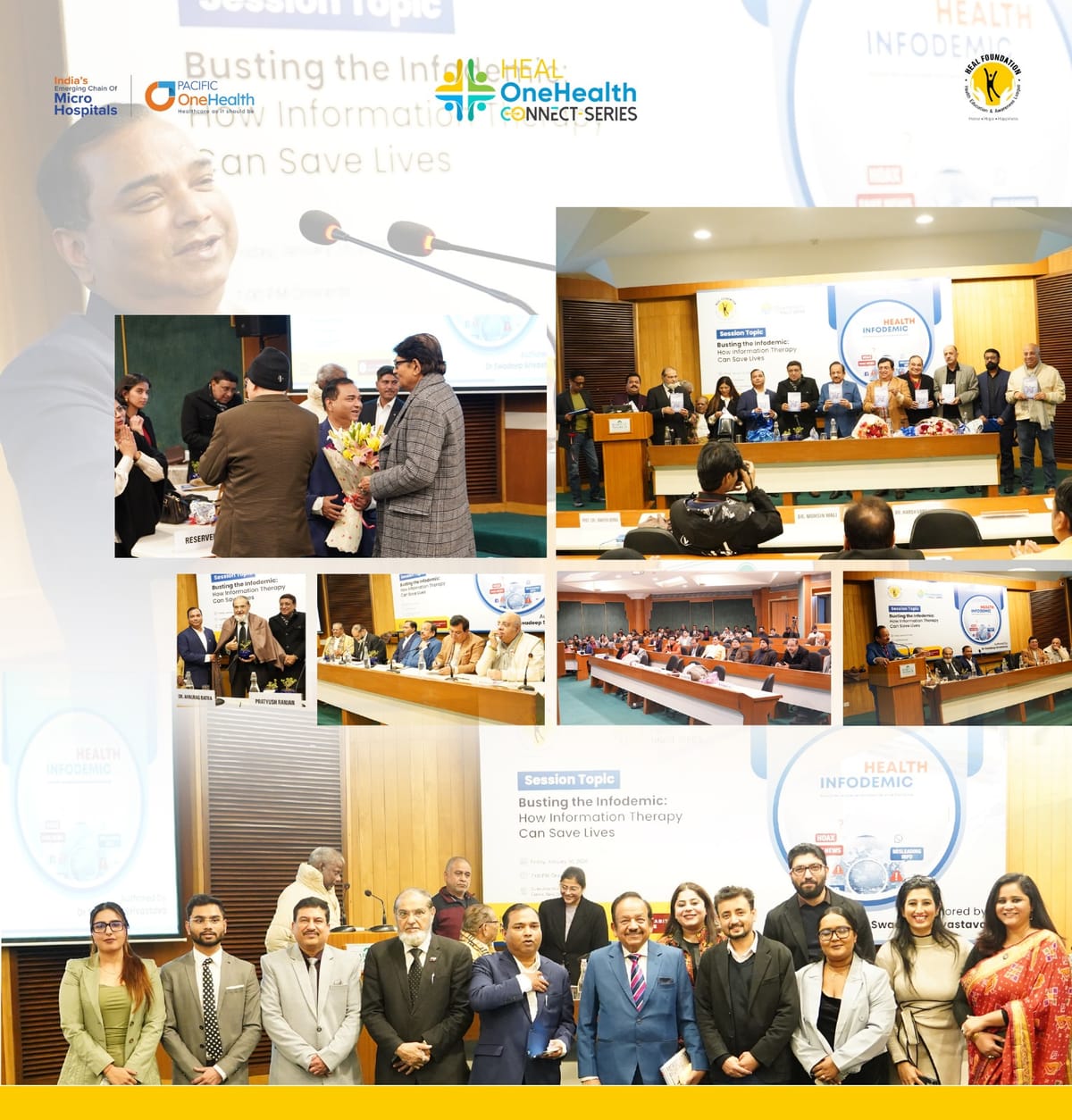
In an era where health misinformation spreads faster than viruses, has quietly emerged as one of the most serious threats to public health—distorting decisions, eroding trust, and costing lives, delaying diagnoses, and exacerbating public health crises, a book ‘Perils of Health Infodemic’ authored by healthcare communication expert Dr. Swadeep Srivastava, was unveiled by Dr. Harsh Vardhan, Former Union Minister of Health & Family Welfare. The new book calls for ‘Information Therapy’ to save lives.
With health misinformation ranging from 1%–51% of vaccine-related posts, 20–30% of YouTube videos on emerging infections being inaccurate, and 69% of misinformation engagement driven by celebrities and politicians, experts warned that the infodemic is eroding trust and delaying life-saving interventions.
Unveiling the book, Dr. Harsh Vardhan, Former Union Minister of Health & Family Welfare, Science & Technology, and Earth Sciences, Government of India, highlighted, asserting, “Health is built on trust, and infodemics corrode that trust—at institutional, policy, and personal levels. Healthcare today is fought on two fronts: the medical and the informational. He also said that while 90% of health outcomes depend on prevention, misinformation diverts attention toward reactive and often harmful choices, weakening public health systems and policy compliance. This book offers a roadmap to restore scientific temper and credibility in India.”
The book contextualises the Science–Society–State model, emphasising that public health victories succeed only when all three move in alignment.
Expanding on the role of institutions, Prof. (Dr) Mahesh Verma, Padma Shri awardee and Vice Chancellor, Guru Gobind Singh Indraprastha University (GGSIPU), said, “Infodemic is one of the biggest threats to mankind today. The media can either amplify myths or become the strongest counter-myth tool. We need structured health communication—Prevent, Protect, Promote—driven by Media, Medical Community, and the Masses. He also urged doctors to actively speak up rather than remain silent spectators.”
Dr. Sunil K Khetarpal, Deputy Director General of the Association of Healthcare Providers (India) and Former CEO & CTO of Rajiv Gandhi Cancer Institute & Research Centre, emphasized, saying, “Misinformation thrives where trust is weak, and communication failure—not medical failure—is the leading cause of patient dissatisfaction. Information therapy is a patient's right; it involves proactive, empathetic listening— just 40 seconds can reduce anxiety significantly. AI cannot replace human touch, ethics, or responsibility; technology must support, not substitute, judgment. Trust your doctor, know what to ask, and prioritize accuracy over virality.”
Author Dr. Swadeep Srivastava, positioned the book as both a diagnosis and a prescription, saying, “COVID-19 exposed how fake news, half-truths, and algorithm-driven content can cause real harm. This book offers practical frameworks to counter misinformation before it translates into medical, social, and economic damage. Healthcare today must extend beyond treatment to education, awareness, and trust.”
Perils of Health Infodemic provides actionable strategies for healthcare professionals, media practitioners, policymakers, and citizens to navigate misleading information through digital hygiene, media literacy, responsible communication, and collective accountability.
As speakers unanimously agreed, while science can defeat viruses, only truthful, responsible communication can defeat the infodemic.