Returns by Design
Amruth Courtyard, Chettinad-inspired wedding business have created a destination venue and are looking to convert distinctive design and cultural appeal into sustained returns.
Finance professional and civil engineer Palaniappan Meyyappan is transforming family farmland near Coimbatore into a Chettinad-inspired wedding business.
For someone who speaks frequently about return on investment, Palaniappan Meyyappan’s move into hospitality began with an underperforming asset. His family’s coconut farmland outside Coimbatore was no longer producing returns that he believed justified the value of the property. A suggestion from his son prompted him to consider whether the land could be used more productively.
The result is Amruth Courtyard, a privately funded wedding and events venue developed over approximately four years. The eight-acre property is divided equally between the venue and continuing agricultural activity. According to Palaniappan, approximately INR 22 crore of the family’s own capital has gone into developing the project, including converting part of the coconut farm into landscaped event infrastructure.
The investment does not include the challenge of acquiring land, since the property was already owned by the family. Nevertheless, transforming agricultural land into a 36,000-sq-ft built environment with courtyards, lawns, kitchens, dining facilities and guest accommodation represents a substantial wager on Coimbatore’s emergence as a wedding and events destination.
Palaniappan is not a hotelier by background. A civil engineer with an MBA, he comes from a family associated with stockbroking and trading and subsequently built his own financial-services business. He says his father provided him with INR 7 lakh as initial capital for that venture. Amruth Courtyard marks a move from managing financial assets to developing and operating a physical one.
His engineering background is visible across the venue. Palaniappan says the project was designed and executed largely in-house with two site engineers, while specialist structural work was outsourced where required. Furniture, seating, gazebos, washbasins and even functional objects such as bins were designed or adapted to fit a broader Chettinad-inspired vocabulary.
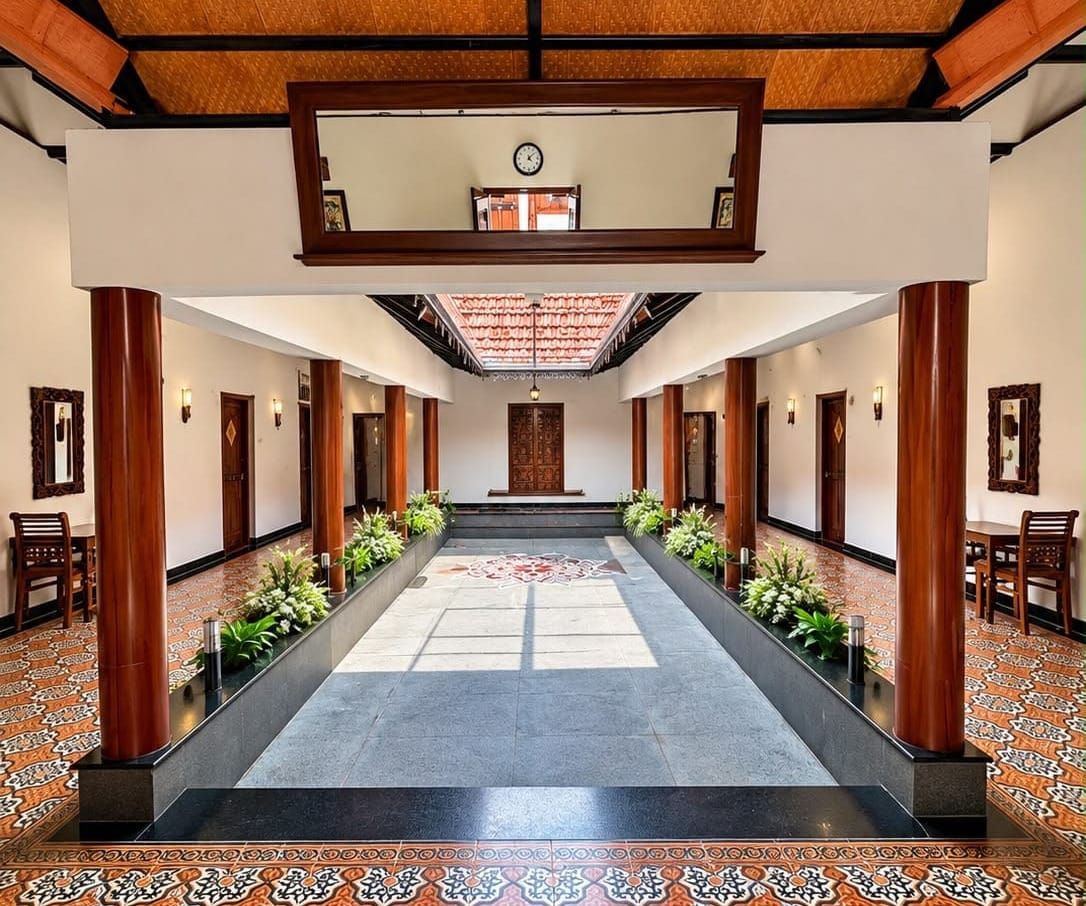
The design draws upon an old-world Chettinad vocabulary while incorporating influences associated with the community’s historic links with countries such as Vietnam and Indonesia. Pillared courtyards, red Mangalore-tiled roofs and Athangudi floor tiles establish the traditional character, while geometric borders, open-air bathroom concepts and other decorative details introduce wider Southeast Asian references. Chessboard motifs and a recurring palette of yellow, red and black appear across floors, walls and bathrooms. Although the property brings together elements from different sources and periods, the repetition of materials, colours and patterns gives its varied spaces a degree of visual unity.
Several details show how the venue has been planned around the practical rhythms of a large Indian wedding. The Veedu Valavu uses an open central courtyard that can be decorated with water and flowers or adapted for ceremonies. Built-in thinnai seating allows guests, particularly older relatives, to remain part of the gathering without depending entirely on movable chairs. Pergolas, stages and lighting points have been positioned to accommodate decoration and photography, while swings, hammocks, a pool and play facilities give guests and children places to spend time between functions. Separate access and accommodation for service personnel help keep catering and event operations away from guest circulation.
That physical product is the venture’s strongest argument. Amruth Courtyard combines large open-air venues with smaller courtyards, traditional seating, landscaped photography locations and 27 guestrooms available to customers. Only one event is accepted at a time, giving wedding parties exclusive use of most of the property. One additional room and a private kitchen are retained for the owners.
The first-day venue rate is approximately INR 11 lakh plus GST, with subsequent days offered at a discount of around 25–30 per cent. The package provides access to the event spaces and accommodation but excludes catering and decoration. Palaniappan estimates that a complete wedding hosted at the property may involve an overall expenditure of around INR 50 lakh, depending on the family’s choices.
Amruth Courtyard therefore captures only part of the total wedding wallet. Families bring their own caterers and decorators or select from vendors recommended by the venue. The property provides preparation areas, burners, refrigeration, grinding equipment and general cooking vessels capable of supporting large gatherings, while specialist vessels, crockery and cutlery are arranged through the caterer.
This model gives customers greater freedom over cuisine, ceremony and expenditure. It may be particularly useful for weddings bringing together North and South Indian families or Indian and international guests with different food and cultural requirements. It also reduces the venue’s exposure to running a permanent food-and-beverage operation.
The trade-off is that Amruth Courtyard relinquishes an important source of hospitality revenue and transfers more coordination to the customer. A family paying for a premium residential wedding may value choice, but some will also expect a single point of responsibility across rooms, food, decoration and event management.
The early booking numbers suggest that the differentiated venue has found a market. During FY2025-26, management says Amruth Courtyard hosted 24 weddings, four corporate events and six paid photo shoots. Weddings consequently accounted for a little over 70 per cent of these 34 bookings by number. Construction was still progressing during FY2024–25, when only a few weddings and receptions were held and there were no photo shoots.
The property has been designed to generate income from several uses without requiring separate infrastructure for each. Weddings and related functions remain central, but the courtyards, lawns, boardroom, dining areas and accommodation can also support corporate gatherings, offsites, exhibitions and social events. Photography provides another revenue stream, including wedding and pre-wedding shoots as well as commercial assignments for textile, jewellery and other lifestyle businesses. The remaining four acres continue to be cultivated, maintaining an agricultural activity alongside the events business, although farming currently contributes only a small share of revenue.
These alternative uses are important because the core wedding market remains highly seasonal. Palaniappan identifies approximately 52 auspicious wedding dates in a year and would eventually like to book all of them. Corporate events, exhibitions and paid photography can help generate income on other dates and improve utilisation of an asset that requires year-round staffing and maintenance.
Customer acquisition presents a similar mixture of strength and vulnerability. Management attributes 60 per cent of confirmed bookings to word of mouth, 30 per cent to WeddingWire and 10 per cent to social media. A high referral share suggests customer satisfaction and trust, both valuable in the family-driven wedding market. It also indicates scope to develop a broader and more diversified marketing engine.
Around 60 per cent of customers are said to come from outside Coimbatore, including families from Kerala and Delhi. This supports the venue’s destination proposition but increases the importance of accommodation, transport coordination and consistent guest services. WeddingWire is retained as a paid channel, while Mandap.com operates on a commission model, although management did not separately identify bookings generated through the latter.
The financial picture is less settled. Management reported revenue of approximately INR 30 lakh in FY2024-25 and provisional revenue of around INR 1 crore in FY2025-26. Farming contributes negligibly, according to Palaniappan, making the reported turnover almost entirely attributable to the venue.
The increase is significant, particularly because the property was still being completed during the earlier period. However, it remains modest against an investment of approximately INR 22 crore. At the reported FY2025-26 turnover, annual revenue amounts to less than five per cent of the original development expenditure. Revenue, of course, is not the same as return.
While return on investment remains important to the business, Amruth Courtyard began, and continues, as a passion project for Palaniappan and his wife, P L Jayalakshmi. Their personal involvement is evident in the time, effort and attention invested in the property’s many architectural, functional and decorative details.
Palaniappan described the business as having reached operating break-even and estimated monthly operating expenses at approximately INR 10-12 lakh. Annualised, this would amount to INR 1.2-1.44 crore, compared with provisional FY2025–26 revenue of around INR 1 crore. He clarified that these figures were approximate, and the apparent difference should therefore not be treated as a definitive measure of profitability. In any case, operating break-even refers to covering expenses and does not mean that the INR 22 crore capital investment has been recovered.
The mismatch does not by itself invalidate the business. Amruth Courtyard remains relatively young, FY2025–26 was its first meaningful operating year, and construction continued alongside commercial activity. It does, however, demonstrate why the next stage must be measured through consistent figures such as realised revenue per event, annual utilisation, operating margin and the time required to recover the development cost.
Amruth Courtyard is run with the involvement of the wider family. Palaniappan’s wife, P L Jayalakshmi, serves as director and finance head, while the original idea to redeploy the farmland followed a suggestion from their son. The promoters say this family-oriented approach also extends to the workforce, with employees regarded as part of the larger Amruth Courtyard family. Palaniappan reports 35 permanent employees and approximately 63 people engaged indirectly through contractors, vendors and maintenance activities. Around 60-70 per cent of the employees are women, and the venue draws operational support from the surrounding community. This creates local employment and can help build staff loyalty, although it also gives the business a significant cost base that must be supported beyond peak wedding dates.
Accommodation is one area where the offering can continue to develop. The introductory pitch described Amruth Courtyard as providing 'luxury accommodations', while the rooms experienced during a two-night hosted stay had a more intimate and homely character. Basic toiletries and in-room provisions were available, although housekeeping, turndown and replenishment could be made more proactive and consistent. Some bathroom tiles in the inspected accommodation also showed visible repairs. These are manageable service and maintenance details, but addressing them would help the stay align more closely with the premium positioning of the larger venue.
This is particularly relevant because the individually designed rooms are intended for the bride, groom and immediate family. The guestrooms around PL Valavu and Mena Valavu are smaller but follow a more conventional and convenient layout. Some of the individually designed rooms incorporate bathrooms reached through a rear passage, an arrangement described as an Indonesian influence. Clear communication, suitable lighting and attentive service can help guests become comfortable with these less familiar design choices.
The issue is not the attractiveness of the venue. Its courtyards, lawns, mountain views, seating and traditional references create a distinctive environment, and the event infrastructure has been thoughtfully developed. Rather, the opportunity is to bring the accommodation and service experience to the same level of detail already visible across the celebration spaces.
Jayalakshmi says the property continues to evolve in response to customer feedback. That willingness will matter as the venture develops from a family-created project into a professionally managed events and hospitality business. More systematic marketing can widen demand, while corporate events, exhibitions and photography bookings can improve off-season utilisation. Stronger housekeeping and guest-service systems can also protect the referrals on which the business currently depends.
Amruth Courtyard has already demonstrated that family farmland can be repositioned as an experience-led event asset. It has also shown that cultural specificity can attract customers beyond the local market. The next question is whether its distinctive architecture, multiple revenue possibilities and growing wedding demand can produce sufficient utilisation and operating profit to justify the capital committed. Palaniappan and his family have delivered the venue by design. Sustainable returns will now depend on execution.
The writer visited the property at the invitation of Amruth Courtyard.