
The Paradox Makers
Built on Concrete, Cemented by Conviction
There is an uncomfortable truth sitting at the heart of India's infrastructure boom. From bridges that enable connectivity, to highways that expand geographic reach, and metro stations that strengthen urban mobility, each is fundamentally underpinned by concrete. Concrete, by its very nature, is a problem. Cement and steel, the two foundational materials of modern construction, together account for roughly 60 per cent of global industrial carbon emissions. The more India builds, the more it emits. It is a paradox that no infrastructure-led economy has yet fully resolved.
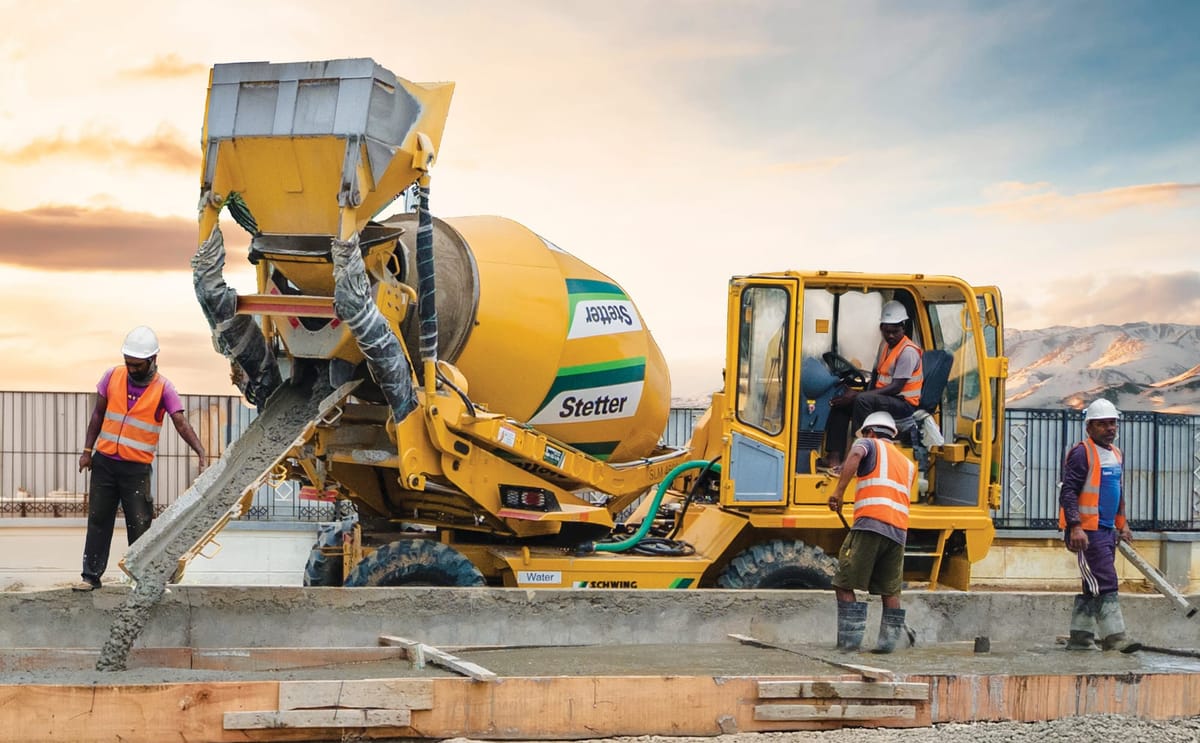
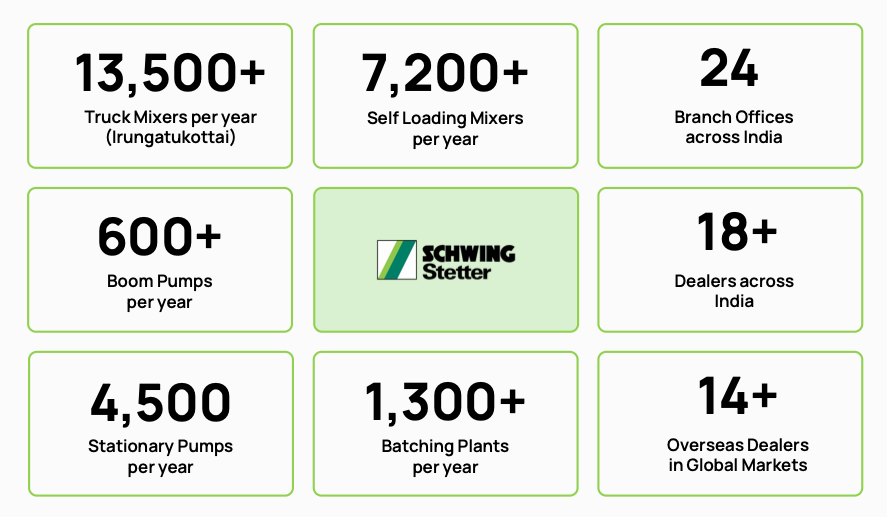
SCHWING Stetter India has spent nearly three decades at the centre of that paradox. Its batching plants have mixed the concrete. Its truck mixers have carried it. Its pumps have placed it in pylons, tunnels, dam walls, and tower foundations from Ladakh to Kanyakumari. The company's equipment has been present at virtually every significant infrastructure project built in modern India. If concrete has a carbon footprint, SCHWING Stetter has, in a very real sense, helped leave it.
Which is precisely why what the company is doing now matters.
As V.G. Sakthikumar, CMD, Schwing Stetter India states, "We are in an industry where we use mostly concrete and we are connected with steel. We thought we will win as much as possible from our side on sustainability."
Over the past several years, SCHWING Stetter India has embarked on a quiet but systematic effort to address the environmental consequences of the industry it helped build. The approach is neither apologetic nor superficial. It runs through the company's operations, its product development, and its engagement with customers and government, and it is beginning to produce results that extend well beyond the factory gates.
The most visible shift is in the product portfolio. At Excon 2025, India's largest construction equipment exhibition, the company launched two products that would have seemed improbable from a concrete equipment manufacturer even five years ago: an electric truck mixer and a hybrid boom pump capable of running on either grid power or diesel. The electric mixer eliminates tailpipe emissions entirely at the site level. The hybrid pump gives contractors the flexibility to use cleaner power where it is available and fall back on diesel where it is not. These are not concept vehicles or prototype demonstrations, they are products entering serial production.
But the more structurally significant innovation is in recycling. The company now manufactures concrete recycling plants that recover reusable aggregate and cement slurry from leftover wet concrete, material that, in standard practice across most Indian construction sites, is dumped into water bodies or on open ground. It is a common and largely invisible form of pollution, and the scale of it is significant given how much excess concrete is generated on any large pour. The recycling plant closes that loop, recovering value from what was previously waste and eliminating a source of environmental damage in the process.
A complementary product: a construction and demolition waste crusher, addresses the problem at the other end of the building lifecycle. When old structures are demolished to make way for new ones, the rubble generated sits in a landfill for centuries without degrading. The crusher reduces that debris into recycled aggregate suitable for use in new concrete production. Research conducted jointly with IIT Madras, under the TLC2 low-carbon construction programme of which SCHWING Stetter is a Platinum Member, indicates that up to 20 per cent of the fresh aggregate in new concrete can be replaced with recycled material without compromising structural integrity. The company has formally submitted this finding to the Government of India as a policy recommendation, a rare instance of a private manufacturer actively lobbying for a regulation that would create demand for its own sustainability products, but doing so on the strength of independent research rather than commercial interest alone.
At its Cheyyar manufacturing hub, solar panels across the factory rooftops now meet approximately 20 per cent of the plant's energy demand, with renewable sources accounting for 33 per cent of total consumption. The company has planted 2,50,000 trees globally. When a village near the Cheyyar factory lost its tamarind grove to highway expansion, the company intervened, sourcing fast-growing hybrid saplings, identifying land near the local lake, and mobilising the entire village in a community replanting exercise. It is a small act in the context of industrial carbon accounting, but it reflects a disposition that runs deeper than compliance.
None of this resolves the fundamental tension between large-scale construction and environmental sustainability. Concrete will continue to be poured, and emissions will continue to be generated. But the direction of travel matters. An industry that once treated environmental cost as an externality is being pushed, product by product and policy recommendation by policy recommendation, toward accountability. SCHWING Stetter India did not create that pressure — but it has chosen, deliberately, to be on the right side of it.