A New Nuclear Chapter: Atoms for net-Zero
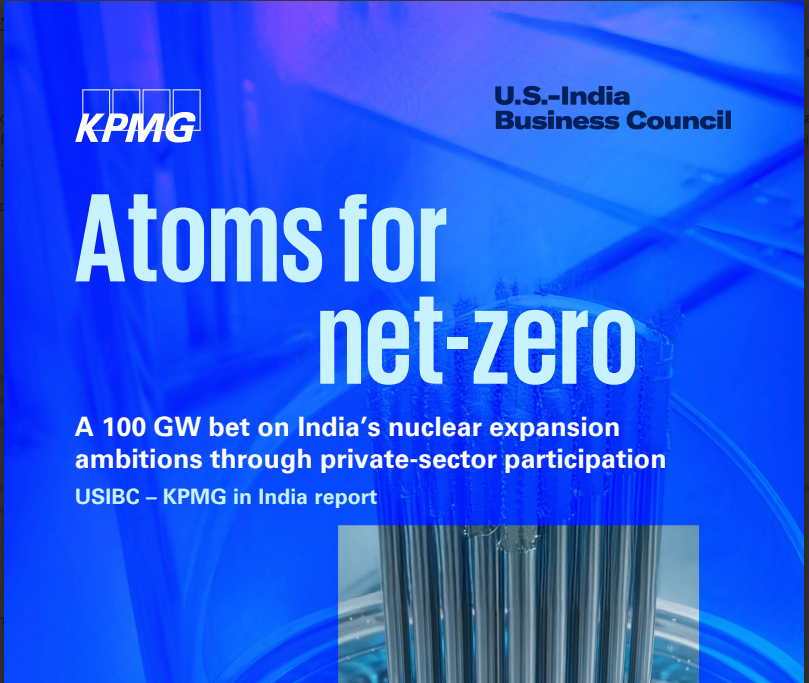
The U.S.–India Business Council (USIBC) and KPMG in India today jointly released “Atoms for Net-Zero”, a landmark report that lays out a roadmap and enabling conditions to scale India’s nuclear energy capacity to 100 GW by 2047. The report positions nuclear power as a strategic pillar for India’s long‑term energy security, industrial competitiveness, and net‑zero ambitions, particularly as electricity demand accelerates alongside manufacturing, digital infrastructure, and clean‑fuel transitions.
The report highlights the strategic role of the India–U.S. energy partnership in accelerating nuclear deployment. Deeper collaboration across technology, regulatory alignment, fuel supply, and manufacturing can position India not only as a large-scale deployment market but also as a global nuclear manufacturing and innovation hub.
India’s nuclear sector is at a defining inflection point, catalysed by the enactment of the SHANTI Act, 2025, which replaces legacy legislation with a modern framework enabling private participation while retaining sovereign control over critical fuel cycle and safety functions. This is reinforced by the National Nuclear Energy Mission, including a proposed INR 20,000 crore investment to accelerate indigenous SMR development.
Beyond technology and capital, Atoms for Net-Zero emphasises the need to build a holistic nuclear ecosystem, encompassing fuel supply and enrichment capabilities, a skilled STEM workforce, and robust back‑end waste and safety frameworks.
“India’s roadmap for nuclear energy is clear—from 22 GW by 2032 to 100 GW by 2047. With the SHANTI Act and the Nuclear Energy Mission, the country has aligned ambition with institutional reform. The focus must now shift decisively to execution, partnerships, and bankable delivery models to translate this historic opportunity into operating capacity,” said Rahul Sharma, Managing Director – India, U.S.–India Business Council.
“Nuclear power can anchor India’s clean energy system by delivering reliable, low‑carbon electricity and industrial heat at scale. This report demonstrates that with predictable regulation, viable financing structures, and standardised technology pathways, India can mobilise private capital and build a safe, competitive, and future‑ready nuclear ecosystem,” said Anish De, Global Head – Energy, Natural Resources & Chemicals, KPMG International.
As India advances towards its 2047 vision, Atoms for net-Zero concludes that timely execution, policy certainty, and sustained industry collaboration will be critical to converting ambition into deployment. Inclusion of nuclear in green finance frameworks and viability gap support for early projects could unlock large-scale capital flows. With enabling reforms now in place and strong domestic and international interest, India is well-positioned to emerge as a key driver of the global clean energy transition.
The report is available here