South India’s steel gap is about product mix, not just capacity: BigMint-backed report
BigMint estimates South India produced 31.1 million tonnes of crude steel against 46.2 million tonnes of capacity in FY26. The figures imply roughly 67% utilisation.
With steelmaking capacity underused, a Quesrow report makes the case for investment in processing and finishing closer to industrial buyers.
South India needs steel that matches its industrial buyers’ specifications, alongside better use of its existing mills, according to a Quesrow report using BigMint data.
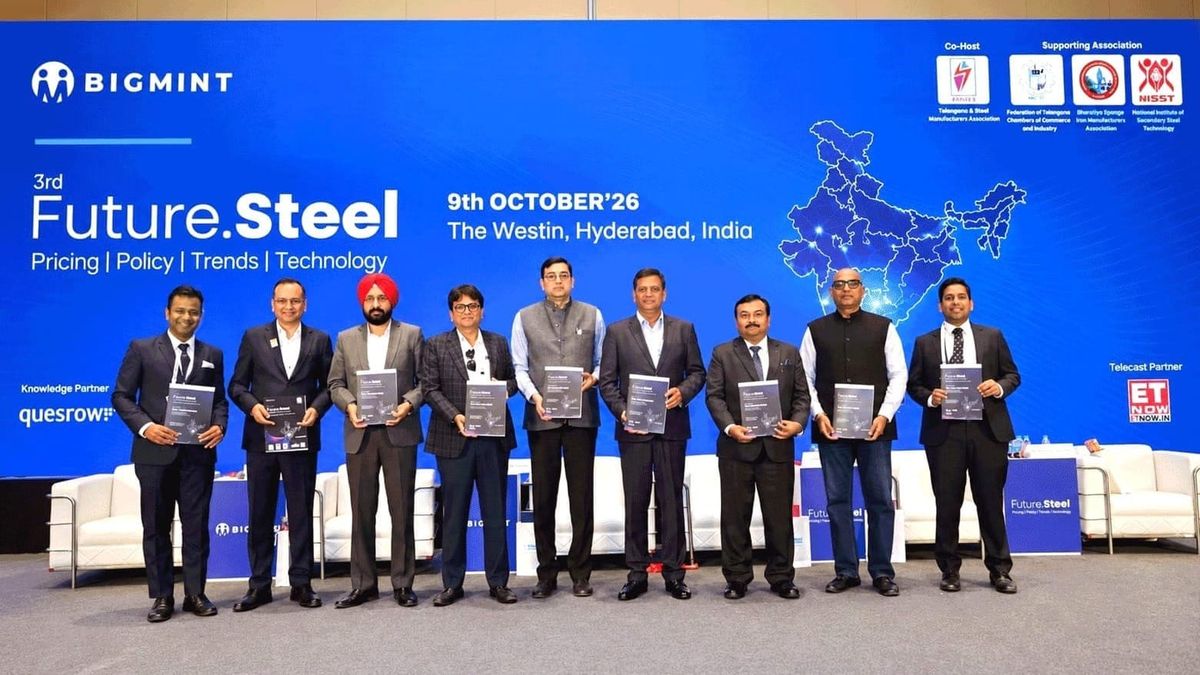
The report, The Structural Gap, presented at BigMint’s Future.Steel conference in Hyderabad on October 9, argues that the region’s steel supply does not adequately match demand from automotive, electronics, appliances and other manufacturing sectors.
It puts South India’s crude steel capacity at 46.22 million tonnes in FY26, against provisional production of 31.70 million tonnes. That implies capacity utilisation of 68.6%, below the report’s national estimate of roughly 72.5%.
Unused capacity, however, does not automatically meet buyers’ requirements. The report describes a regional supply base weighted towards long products, including reinforcement bars and structural steel, while manufacturers source higher-specification flat, coated and specialised products from other regions and overseas.
Its investment argument therefore centres on converting and finishing steel near customers. It recommends rolling, galvanising and coating facilities, alongside service centres that slit, cut and blank material and hold certified stock. Such facilities could process steel brought in by rail or sea into products suited to local buyers.
The report also recommends improving utilisation at existing plants before adding furnaces, and securing raw material supplies before expanding steelmaking.
Scrap availability is one constraint. According to the report, scrap accounts for 36.4% of the metallic charge used by South India’s electric arc and induction furnaces, compared with 30.5% nationally. The region imported 1.63 million tonnes of ferrous scrap in FY26, out of India’s total of 6.82 million tonnes. Organised collection, shredding and reliable supply contracts form part of its proposed response.
The report projects regional crude steel capacity of 61.30 million tonnes by FY30, an increase of 15.08 million tonnes. Andhra Pradesh accounts for 11.20 million tonnes of that projected addition.
That pipeline includes a proposed 8.2 million tonne integrated project listed on an environmental-clearance and consent-to-establish basis. The forecast should therefore be read as a pipeline estimate rather than confirmed commissioning commitments.
For steel producers and processors, the report’s central proposition is that supplying the required grades, dimensions and service near industrial clusters could offer a stronger investment case than adding melting capacity alone.