India’s data centre pipeline is 2.7 times its operating capacity, the highest among emerging markets
S&P Global Ratings finds emerging markets hold 35 percent of global data centre capacity, with India’s development pipeline the largest relative to what it already runs.
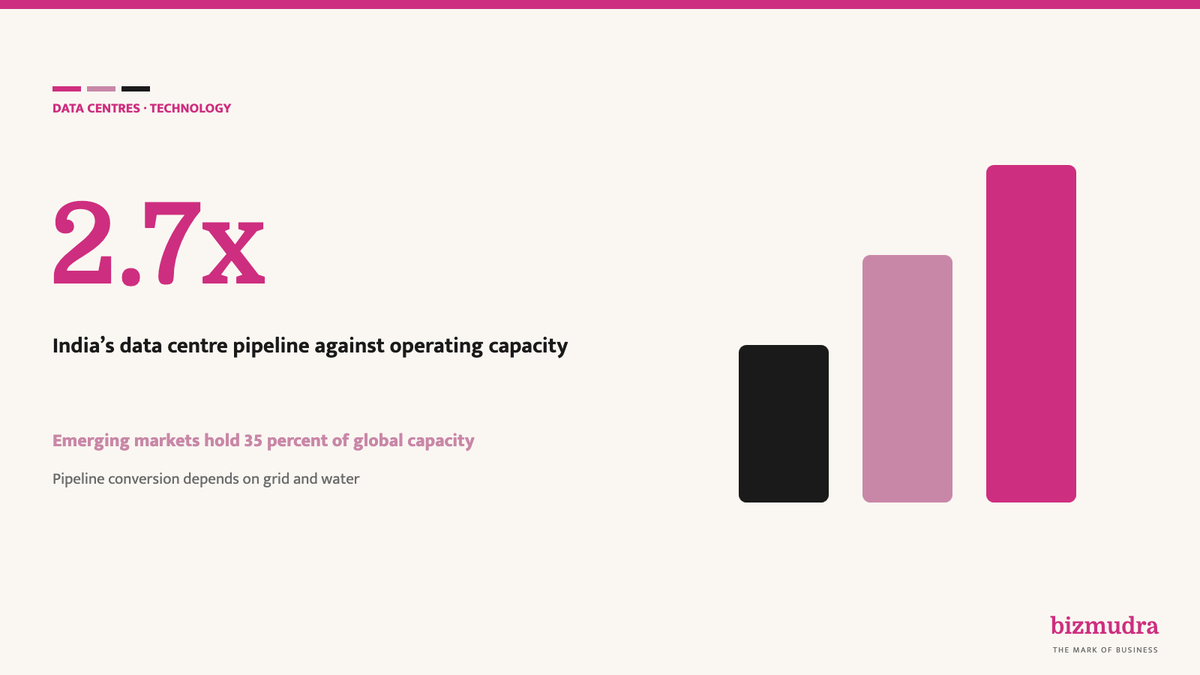
India has the largest data centre development pipeline relative to its operating capacity among emerging markets, at 2.7 times, according to a report published on 3 September by S&P Global Ratings. Brazil is second at 1.9 times.
The report finds emerging markets already account for 35 percent of global data centre capacity, with China holding more than 60 percent of that share, and that the combined development pipeline across emerging markets is close to twice current operating capacity.
S&P’s argument is that the pipeline will not convert evenly. It expects capacity to land in markets with reliable grids, clear permitting, access to renewables and available capital, and names India alongside China, Malaysia and the United Arab Emirates as comparatively well positioned to attract AI-related investment. Energy and water are the constraints it flags, particularly in hubs where expansion coincides with grid bottlenecks or water stress. The report maps Maharashtra, Karnataka, Tamil Nadu, Andhra Pradesh, Telangana, Rajasthan and Gujarat among the locations carrying that exposure.
The report also raises a social risk that has so far had little airing in India: developers may face opposition if data centre expansion is seen to raise electricity costs, weaken grid reliability, or compete with local users for water and land. That opposition is already shaping approvals in developed markets and in Malaysia, which has tightened permitting.
The capacity data draws on 451 Research, an S&P Global business. The report notes its transaction figures cover recorded mergers and acquisitions, equity and debt deals between 2019 and 2025, and exclude announced greenfield investment and sovereign commitments, so the investment picture is narrower than headline announcements suggest.