India's freight starts to go electric
Is freight decarbonisation in India starting to move from corporate pledges to actual vehicles?
One enterprise fleet at a time
In the space of a few days, three of India's larger companies moved to shift freight onto cleaner trucks: cement maker JK Cement put heavy electric trucks on the road, FMCG group Dabur turned to gas-powered haulage, and fleet operator Green Drive expanded an electric last-mile push with Euler Motors. Individually, each is modest. Together, they mark the point at which freight decarbonisation in India is starting to move from corporate pledges to actual vehicles, even if the numbers stay small.
Freight is the hard part of India's emissions problem. Medium and heavy trucks make up only about 3% of vehicles on the road, the ICCT estimates, yet they produce roughly 44% of road transport's carbon dioxide and haul about 70% of the country's goods. That freight task is set to grow fivefold, from nearly 2,000 billion tonne-kilometres in 2020 to more than 10,000 billion by 2050, on CEEW's projections, in a logistics system that still costs 13 to 14% of GDP against a government target of nearer 8%. Cutting truck emissions is both an environmental and an economic prize, and the pull is increasingly coming from large shippers with their own net-zero and supply-chain targets.
Multiple deals, with different bets
These deals show how uneven and early the shift is. At the heavy end, JK Cement has begun hauling cement on 55-tonne battery-electric trucks supplied through mobility operator Billion Electric, 20 running now and more than 150 planned this financial year, in the toughest, most emissions-heavy segment to electrify. Days later a second cement major followed: Wonder Cement ordered around 250 of Montra Electric's 55-tonne Rhino trucks for a 1,450-km corridor across four states, of which about 65 have been delivered so far. Two cement makers electrifying heavy haul in the same window is the clearest sign yet that the sector, not FMCG or last-mile, is out in front of India's freight shift.
At the light end, Euler Motors is deploying electric cargo four-wheelers across Green Drive's last-mile network, around 50 so far and 500 targeted this year, the easiest use case of short urban runs. Dabur has gone a different route entirely, contracting Essar's GreenLine to run LNG-powered trucks; gas cuts emissions against diesel but is still a fossil fuel, a transitional option rather than a zero-emission one, and GreenLine disclosed neither fleet size nor target. Between them: battery versus gas, last-mile versus long-haul, cement versus FMCG. (Deployment figures are the companies' own.)
A trickle, not a wave
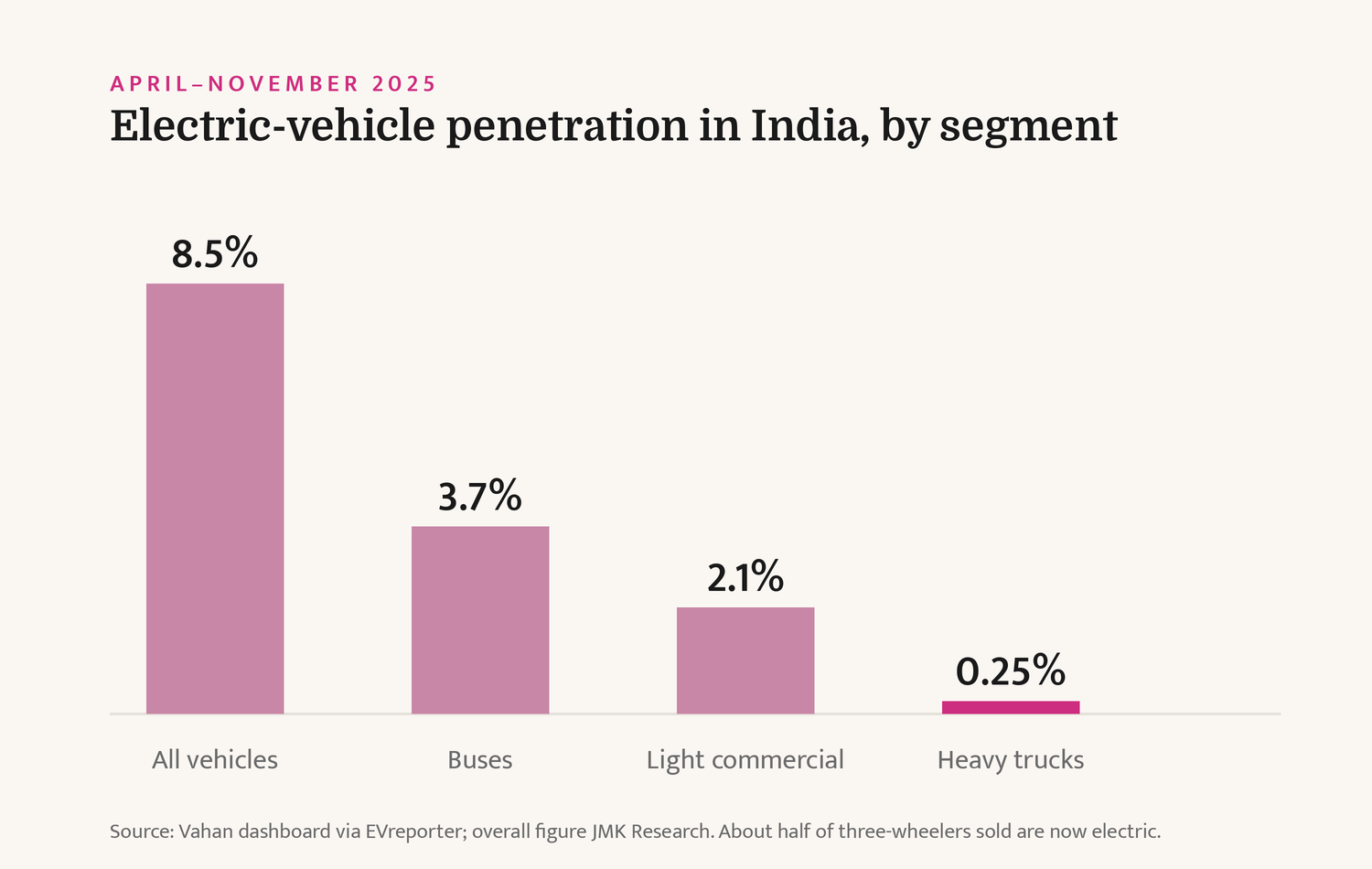
Set against the wider market, the deals look less like a wave than a trickle. Of the 170,000-odd heavy goods vehicles registered in India between April and November 2025, just 419 were electric, a penetration of about 0.25%, on Vahan data compiled by EVreporter. Electric goods vehicles as a whole reached only 1.4% of their segment even after jumping 172% year on year, per JMK Research, and RMI counts roughly 1,000 electric-truck sales in all of 2025. For contrast, about half of the three-wheelers India sells are now electric. Trucks are where freight electrification is hardest and slowest.
Why the caution
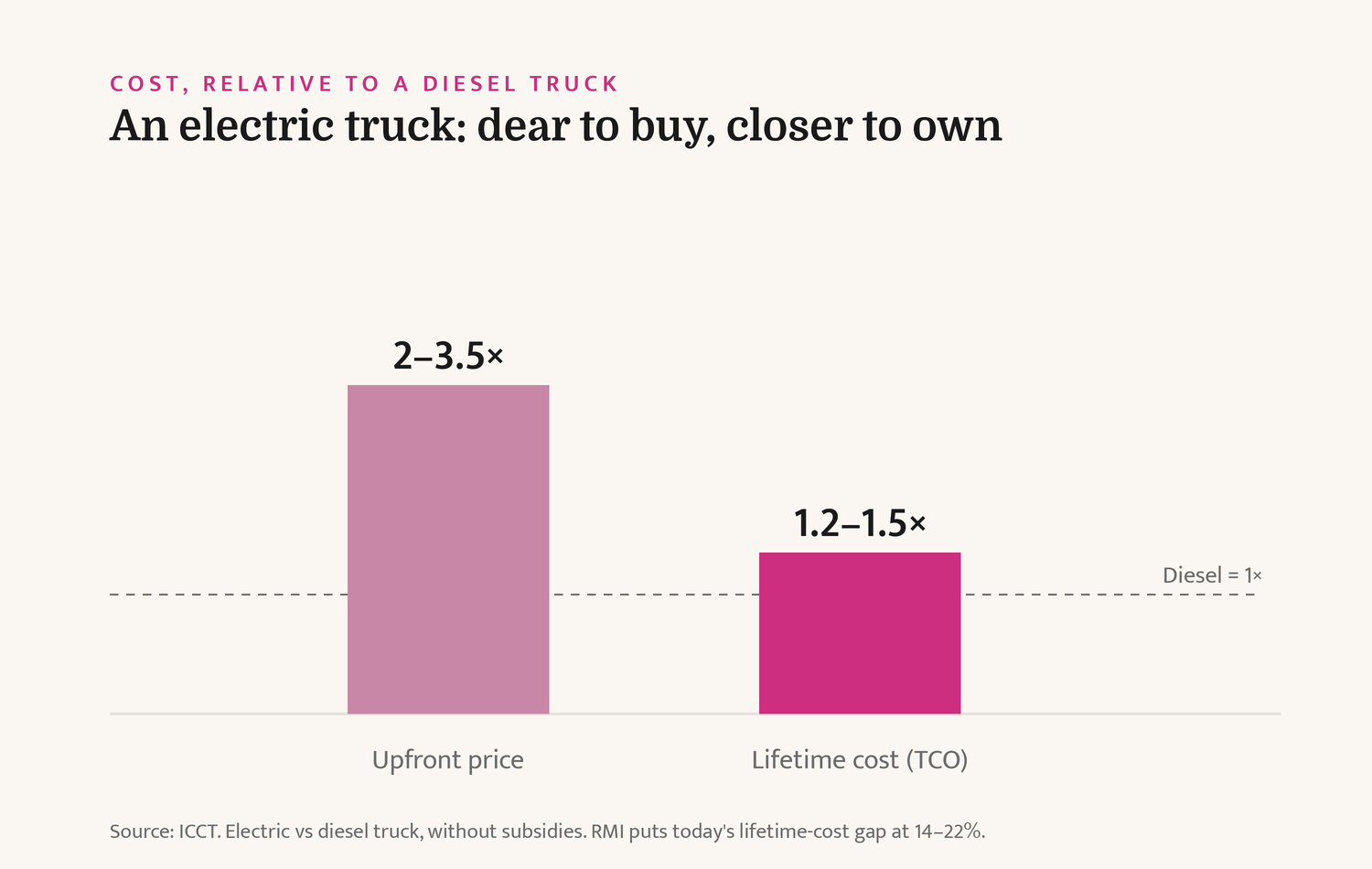
The economics explain the caution, and the direction. An electric truck still costs two to three and a half times as much as a diesel one to buy, the ICCT finds, though lower running costs narrow the lifetime, or total-cost-of-ownership, gap to about 1.2 to 1.5 times; RMI puts today's gap at 14 to 22% without subsidies and reckons heavy-duty trucks could reach cost parity around 2027. The swing factor is the price of charging: RMI finds electricity alone can account for 30 to 50% of an electric truck's ownership cost over seven years. But the obvious levers are modest; shifting to a power-purchase agreement lowers the average charging price to about INR 11.4 a unit and trims lifetime cost by only 6%, while managed charging saves 2%. Neither closes a 14 to 22% gap on its own.
Policy arrives; infrastructure starts to follow
Policy has begun to help. In 2025 the government, for the first time, brought heavy trucks into its EV incentives, earmarking INR 500 crore under the PM E-DRIVE scheme, since extended to 2028, for around 5,600 e-trucks, with subsidies of up to INR 9.6 lakh a vehicle and cement, steel, ports and logistics flagged as early adopters. But the enabling infrastructure lags badly: RMI estimates only about 5% of India's chargers can meet a truck's power needs.
Something has begun to move on that 5%. In late July, Energy In Motion, the electric-truck arm of listed Ravindra Energy, signed an agreement with state-run HPCL to put battery-swapping and fast-charging hubs on the oil marketer's forecourts, starting with the Mumbai–Pune, Delhi–Jaipur and Chennai–Bangalore freight corridors over the next 18 to 24 months. The division of labour is the useful detail: EIM owns and runs the batteries and the swap hardware, while HPCL supplies the site, the power and the amenities, across a network the company says exceeds 25,000 outlets. EIM says it already operates six heavy-duty swap stations in Delhi-NCR and at JNPA, handling around 840 swaps a day, and is targeting 40 stations by March 2027, with a swap taking about seven minutes.
What makes it more than a charging announcement is where it puts the battery. EIM sells 'bare' trucks without batteries and sells the energy as a service, which goes at the upfront cost, the two to three and a half times a diesel truck that the ICCT measures, rather than at the running cost. That matters because the running-cost levers are weak: on RMI's numbers a power-purchase agreement trims lifetime cost by about 6% and managed charging by 2%, against a gap of 14 to 22%. Taking the most expensive component off the vehicle is a different order of intervention, and it is aimed squarely at the segment the cement makers are electrifying — EIM's own Ashwa is a 55-tonne tractor, the same class as JK Cement's trucks and Wonder Cement's Rhinos.
The usual caveat applies, and it is the same one that applies to the freight deals themselves: the numbers that would decide how much this matters, how many outlets in phase one, and what each side is investing, have not been disclosed, and corridor hubs on an 18-to-24-month plan are not yet an operating network.
The gap between ambition and asphalt
That gap between ambition and asphalt is the real story. It shows up across the board: 10,000 electric buses have been sanctioned under a separate scheme, yet only four cities had them running by February 2026. It explains the shape of these freight deals, too. Shippers are not buying trucks outright but leaning on intermediaries: Billion Electric bundles trucks, charging and financing and draws on sister company ChargeZone's chargers; GreenLine runs its own LNG refuelling network; Green Drive operates the fleet as a service; Energy In Motion goes furthest, retaining ownership of the batteries themselves and selling the energy by the swap. Billion Electric and Energy In Motion are two answers to the same corridor problem — one captive, through a sister company's chargers, the other renting space on a state oil marketer's forecourt.
The capital cost and the range-and-charging risk sit with the operator, not the cement or soap maker, and most of the headline numbers are targets, not trucks on the road.
So the week's deals are best read as early signals, not a tipping point. Whether they scale will turn less on corporate enthusiasm than on the dull essentials: whether corridor hubs like HPCL's actually get built, financing that banks still treat warily, and whether the cost maths that work on paper hold on the highway. For now, India's freight is beginning to move off diesel, in ones and tens rather than thousands.
Updated 31 July 2026 to add the HPCL–Energy In Motion corridor agreement.