Is this a Diesel Killer?
Aimed towards the 90 percent of the market that has not gone electric, MG has bet on its ADAPT platform to bring out MG Hector Tomahawk PHEV.
Why MG priced its Plug-In Hybrid against Diesel SUVs, not its own EV
JSW MG Motor India's leadership says the Hector Tomahawk PHEV is not aimed at EV buyers at all. It is aimed at the 90 percent of the market that has not gone electric, and a 40 percent tax rate is the thing standing in its way.
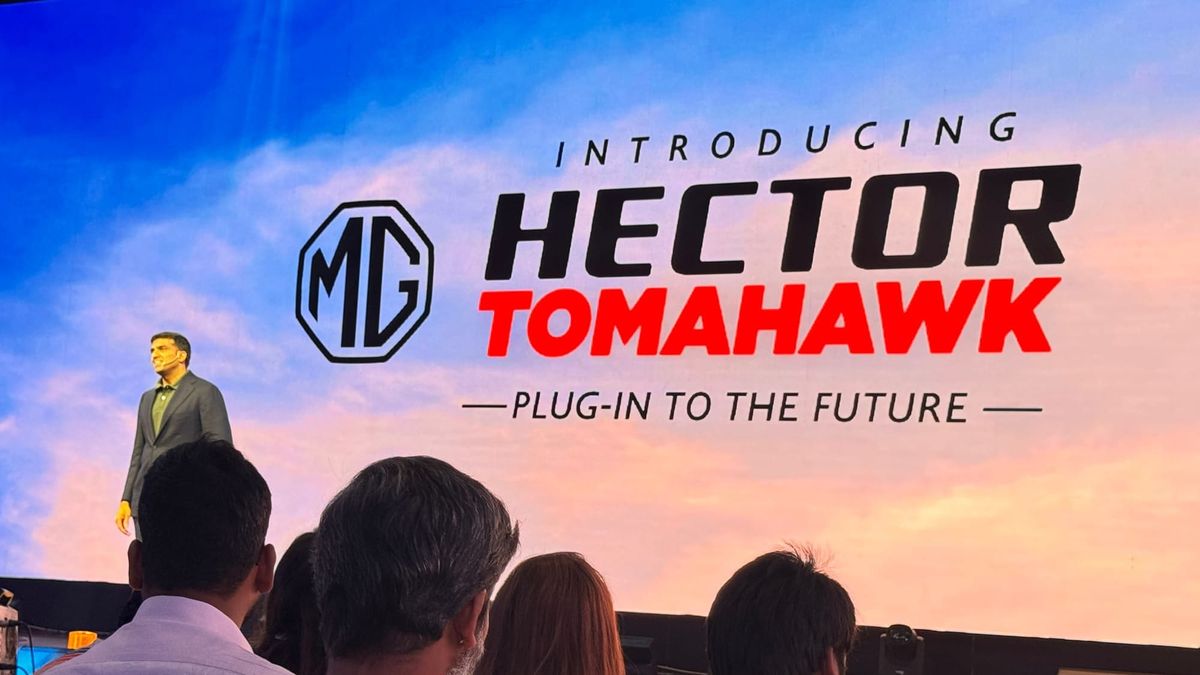
At the launch of the Hector Tomahawk, the obvious question was why anyone would pay a premium for the plug-in hybrid when the same SUV is available as a full EV for several lakh less. Speaking to reporters afterwards, JSW MG's leadership made clear that this framing misses the point entirely.
"Our nomenclature for the PHEV is diesel killer," Parth Jindal said. "We want to absolutely take on diesel with this product. We want to attract the 90 percent of the people who are not buying EVs to new energy," Jindal said. "Our competition set is diesel."
The reasoning is arithmetic. EV penetration in India is currently around 8 percent and expected to close the year between 9 and 10 percent. That leaves the overwhelming majority of the market buying petrol and diesel.
Measured that way, the pricing looks different. The PHEV starts at Rs 21.79 lakh under Battery-as-a-Service with a Rs 3.20 per km battery rental, or Rs 25.69 lakh ex-showroom. MG says both figures sit alongside top-end diesel automatics rather than above them.
The 40 percent problem
The company was blunt about what constrains it. "There's a 40 percent GST on PHEVs. It's not 5 percent like EVs," Jindal said. "We would have loved to price it even better, but our hands are tied."
He added that the comparison still holds because diesel carries the same 40 percent rate, which is precisely why MG has positioned the car where it has.
Whether that changes is now a live policy question, and MG's reading of the government's thinking is unusually specific. The distinction being drawn, executives said, is about what actually turns the wheels. A strong hybrid is treated as an improved internal combustion car, because the engine drives the drivetrain. A plug-in hybrid falls into the same bucket, because even if the car runs on electricity most of the time, the engine can still drive the wheels directly. A range-extender EV is different. The engine only works as a generator, and the wheels are always driven by the battery.
"In CAFE 3 they have classified it this way, and we are very hopeful that this is also how it gets classified from a taxation point of view, or something intermediate," MG said, floating the possibility of a graded structure with 5 percent for battery electrics and something lower than 40 for range extenders.
The counter-argument, executives conceded, is a fair one. A plug-in hybrid whose owner never plugs it in is simply a heavier, less efficient hybrid. "Government is saying that. And we understand 90 percent of the time people will run it in India on EV mode, because that is why they are buying it. But it's still not an EV."
Supply, not demand
Managing Director Anurag Mehrotra pushed back on the idea that recent EV growth is a temporary blip driven by policy noise, arguing the constraint has always been products rather than buyers.
"In 2015, SUV penetration in India was less than 5 percent and there were hardly any OEMs offering SUVs below Rs 20 lakh," he said. "Fast forward ten years, SUV penetration is 65 percent and every OEM has SUVs in the sub-Rs 20 lakh band. The same is the story on NEVs. It is not a demand side issue. It is a supply side issue."
He pointed to the segment the Tomahawk enters as evidence. What was a 3,000 to 4,000 unit-a-month market has grown to around 10,000. "We are coming in, we will also expand the market."
MG expects the broader EV market to reach roughly 450,000 units this year, against about 200,000 last year, with monthly volumes already running at 35,000 to 37,000 before the festive season.
BaaS, buybacks and the resale question
Battery-as-a-Service accounts for only 5 to 7 percent of MG's sales, but the company argues its real value is educational rather than commercial. It reframes the price comparison a customer makes between an EV and a petrol car, and it gets people into showrooms. "Any instrument that allows you to get people to experience an NEV is most welcome," MG said, citing survey data that around 90 percent of buyers who try an EV do not return to petrol or diesel.
On resale, the anxiety that shadows every EV purchase in India, MG offers an assured buyback across its range. Customers pay a fee upfront and lock in a guaranteed residual: 60 percent at three years, 55 percent at four, 50 percent at five. On the Windsor, that fee is around Rs 30,000.
The high-voltage battery carries an eight-year guarantee, after which MG says it can refurbish packs by diagnosing and replacing problem cells at relatively low cost. Owners can even choose the state of charge they want restored, priced accordingly.
Behind that confidence is a second-life plan. MG expects EVs priced below Rs 15 lakh to find their way into fleets, with corporate and technology-sector employers increasingly mandating green vehicles. "There are no good, reliable EVs in the fleet segment," executives said, which is why they are comfortable guaranteeing buybacks.
Hector Tomahawk EV deliveries begin in September. The PHEV follows in November.