The Capital-Efficiency Bet
MG's ADAPT platform runs four powertrains off one architecture: a capital-efficiency bet on flexibility. A shrewd hedge, or hard to prove at scale?
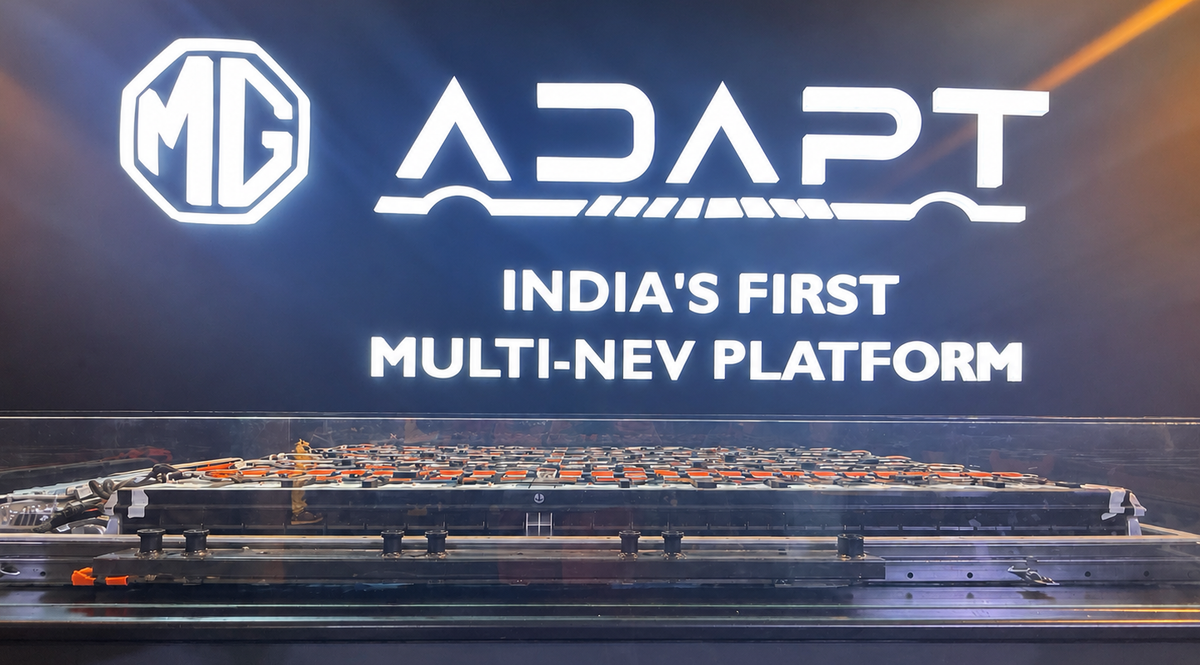
JSW MG's new ADAPT platform is a deliberate wager on flexibility over firepower: a capital-disciplined answer to a market that hasn't yet decided how fast it wants to go electric.
Ask Anurag Mehrotra about MG's newest platform and the answer is all business. The Managing Director of JSW MG Motor India goes straight to the balance sheet on why the company has built four powertrains into a single architecture. "It's more capital-efficient to do a single platform with multiple powertrains," he says. Building two instead — one for electric and range-extenders, another for the hybrids — "would have cost me 2x to build."
That candour is the key to reading MG ADAPT. Unveiled in Gurugram on 16 July, the platform: MG's first architecture able to run battery-electric (BEV), hybrid (HEV), plug-in-hybrid (PHEV) and range-extender (REEV) vehicles off a common base, was displayed with all the trappings of a technology showcase. The platform claimed to have world-first electromagnetic hybrid transmission, 800V charging (most EVs have upto 400V), and an intelligent energy-management system that shuffles between four drive modes. But its real significance is strategic. ADAPT is a bet that, in a market still finding its feet on electrification, flexibility is worth more than commitment to any single path.
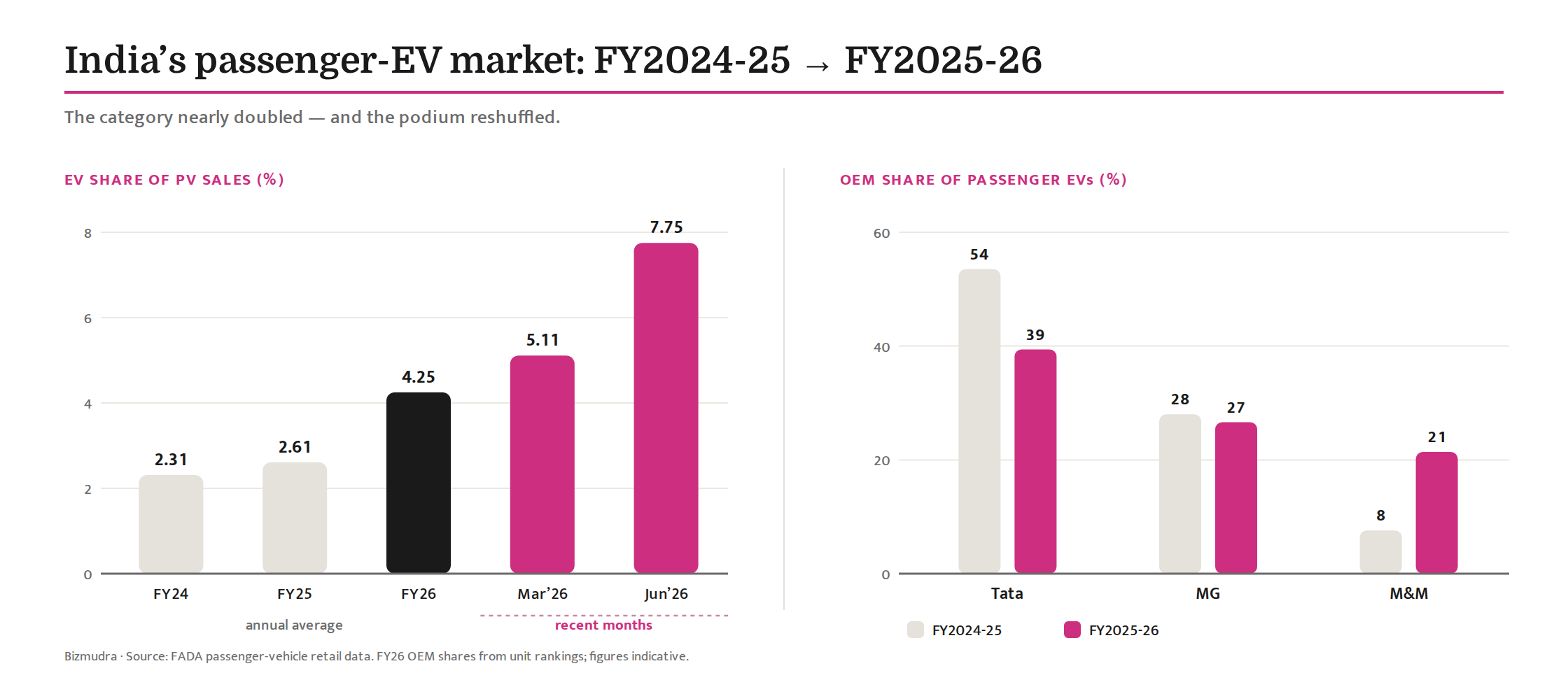
The timing is deliberate. India's passenger-EV market is expanding fast: sales nearly doubled in FY2025-26 to around 1.98 lakh units, penetration rising from 2.6% a year earlier to roughly 4.3%, with monthly share touching 5.1% by March and 7.75% by June. MG has been a central player in that growth, finishing the year as India's second-largest electric-car seller, largely on the strength of one product, the Windsor. The competition, though, is intensifying: a field once dominated by Tata has broadened into a genuine three-way contest, with Mahindra scaling quickly and pressing MG hard in the most recent months.
And the economics of scaling remain demanding. The joint venture reported a loss of around INR 1,096 crore (roughly $121 million) in FY25 even as revenue crossed a billion dollars, a reminder that volume alone has not yet turned into profit. Against that backdrop, a platform that spreads its development cost across many powertrains and body styles is a logical way to compete without overextending.
The logic of the hedge
Mehrotra is direct about the reasoning. "The platform is common, the top hat is unique", he says: one base, many bodies, and "the unlock for capital efficiency". He is also clear that he is not chasing rankings for their own sake. "I am not in a rat race", he says. "The challenge is not demand, it's supply, meaning more models. NEVs are at 8-9%; 92% of the market is still left." It is a well-grounded argument: SUVs grew from under 5% of the market to roughly two-thirds precisely because many carmakers offered multiple models across a range of price points. On that reading, the task is to widen the range, not win a monthly scoreboard.
The deeper rationale is the customer. "In India, there's no single customer", Mehrotra argues, describing at least different buyer groups with distinct needs giving examples, "My in-laws are 75; they don't want range anxiety, so they'd take a plug-in hybrid, while my son is an early adopter, so he'd go straight for BEV". A platform that can be a hybrid, a plug-in, a range-extender or a pure EV, depending on how the battery and fuel tank are sized, lets MG serve all of them without wagering the company on the pace of the transition.
That breadth is a real strategic choice, and it is worth weighing against the alternative. Tata and Mahindra have gone born-electric, engineering platforms optimised for a single job; MG is betting the other way. For them, range beats specialisation while the market is still forming. Both approaches have merit, and there are trade-offs to watch on MG's side. Plug-in hybrids and range-extenders still use petrol, and hybrids currently draw none of the 5% GST benefit or purchase support that pure EVs enjoy. That is why when was asked Mehrotra whether hybrids should be incentivised, he makes the case plainly: "I think it should be given". Whether flexibility or focus proves the better read of the Indian market is a genuinely open question, and one of the more interesting bets in the sector right now.
China for the brains
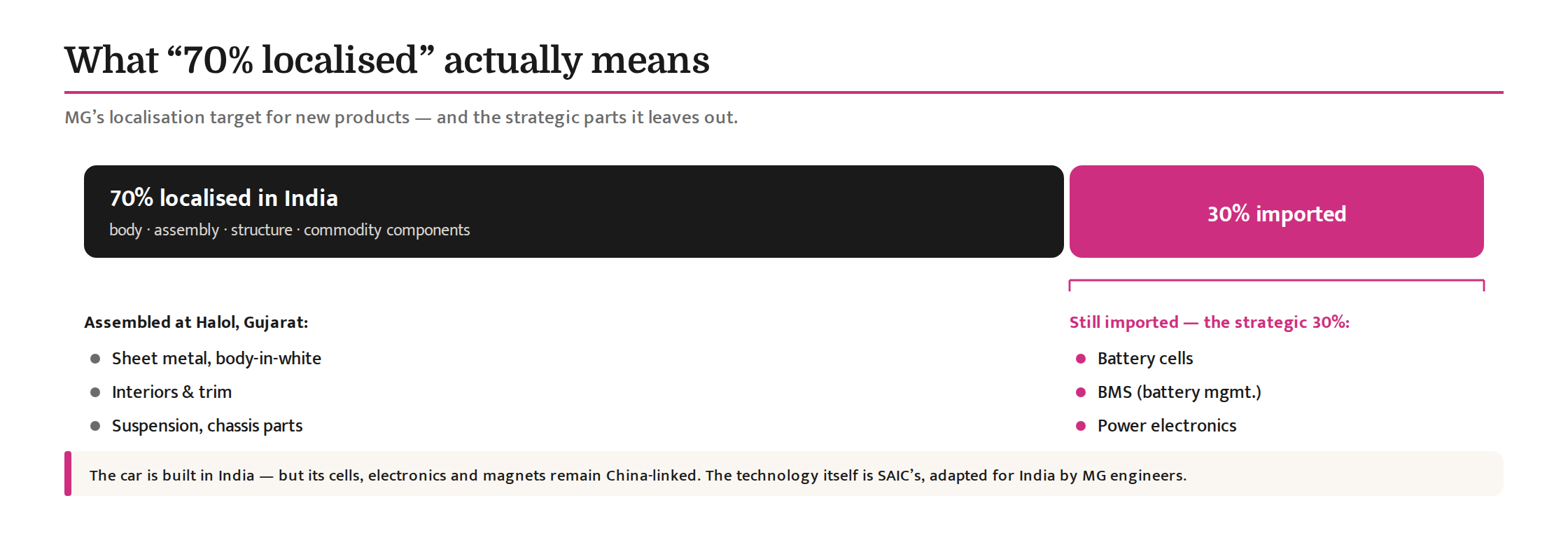
A second question the platform raises is how much of ADAPT is MG's own, and how quickly it can be localised. Mehrotra commits to 70% localisation for new products and is candid about what will still be imported. "The cell for sure", he says, "and some proprietary technology items that every OEM is still importing," a fair point, since cell and advanced-component imports are an industry-wide reality rather than an MG-specific one. Pushed on the battery-management system, he confirms it too is imported; and asked whether the platform is India's own or adapted from partner SAIC's global architecture, he indicates the latter, customised for Indian conditions by MG's engineers. In practice, the 70% covers the body, the assembly and the commodity value, while the cells, the electronics and much of the core technology remain, for now, China-sourced.
That matters because JSW is separately working to raise its stake toward a controlling position in the venture. Ownership of the company and ownership of the underlying technology are not the same thing, and how that gap narrows, and how much intellectual property and engineering capability MG builds in-house over time, is one of the more telling threads to follow. For now, the shorthand is fair: the cars are increasingly built in India, while the technology behind them is still largely SAIC's.
Two platforms, one question
One further strategic point surfaced almost in passing. Asked whether ADAPT would also be shared with JSW Motors, the group's separate, Chery-linked car brand, Mehrotra was unequivocal: "No". So the JSW Group is, for now, developing two China-derived vehicle platforms in parallel, SAIC's for MG and Chery's for JSW Motors, aimed at overlapping segments. For a group that prizes capital efficiency, how those two programmes stay distinct, and what each is ultimately meant to own, is a question worth returning to as both brands scale.
None of this detracts from the logic of ADAPT. For a carmaker still building toward profitable scale, a flexible, capital-light platform built on a partner's proven technology is a defensible and arguably shrewd way to widen its range while the market settles. The open question is execution. A platform can improve the odds and lift the ceiling on margins; scale and delivery have to do the rest. MG has made a clear, considered bet. The next four to six quarters will show whether the flexibility pays off: profitable volume, rising localisation, and how MG holds up as Tata and Mahindra press.