
August auto sales surge
Tata Motors passenger vehicle sales rose 56 percent and Hyundai posted its best ever August, though last year's base was depressed by buyers deferring purchases ahead of expected GST changes.
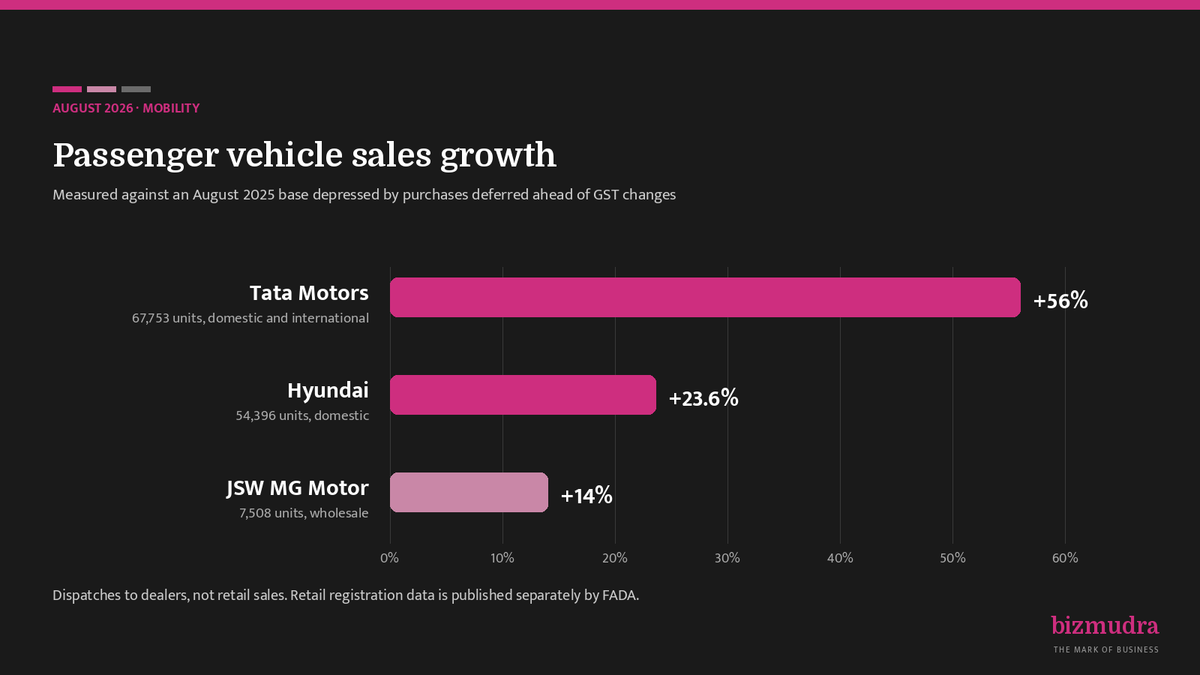
But the comparison is against a GST-hit month
India's vehicle makers reported sharp year-on-year growth in August, led by a 56 percent rise at Tata Motors Passenger Vehicles, though the headline numbers are measured against a month last year when buyers deferred purchases ahead of expected GST changes.
Mahindra made the point in its own release, noting that volumes were muted in August 2025 due to anticipated GST changes and that this month's growth reflects that low base.
Tata Motors Passenger Vehicles sold 67,753 units across domestic and international markets, against 43,315 a year earlier. Hyundai Motor India reported domestic sales of 54,396 units, up 23.6 percent and its highest for any August, with total sales including exports at 65,796 units, up 8.8 percent. For April to August, Hyundai's domestic sales are up 12.6 percent.
In two-wheelers, Hero MotoCorp dispatched 5,68,398 units against 5,53,727 a year earlier, a smaller gain, though the company said VAHAN registrations grew 19 percent, indicating retail demand ran ahead of dispatches. Its electric arm VIDA dispatched 25,558 units with VAHAN growth of 38 percent.
Hero's figures illustrate a wider point. Its dispatches rose about 2.6 percent year on year while retail registrations grew 19 percent, meaning vehicles left dealerships faster than they arrived and channel inventory was drawn down ahead of the festive season.
JSW MG Motor India reported wholesale sales of 7,508 units, up 14 percent.
Away from passenger vehicles the picture is more mixed. Mahindra's farm equipment business sold 27,595 tractors domestically, up 5 percent, with exports flat at 1,912 units, though cumulative domestic tractor sales for the year to August are up 17 percent. Its trucks and buses business sold 2,495 vehicles, up 47 percent, a figure the company attributed partly to the low base.
A caveat applies to all of these figures beyond the base effect. The numbers manufacturers publish are dispatches to dealers, not sales to customers. Retail registration data is published separately by dealer body FADA, drawn from the ministry's VAHAN platform, and the two have diverged in the past. FADA has argued since 2018 that the industry should report registrations rather than wholesales, on the grounds that retail numbers make demand easier to read and inventory easier to manage. FADA's August retail figures are expected shortly.
Executives pointed to the festive season ahead. Mahindra's farm equipment president Veejay Nakra cited improved rainfall and near-normal Kharif sowing supporting rural sentiment, while its trucks and buses chairman Vinod Sahay cited infrastructure spending and freight demand alongside rising input and fuel costs.
The tractor and truck numbers are the ones worth watching, since neither carries the same base distortion as passenger vehicles and both track rural income and freight activity.
Kolkata-based Motovolt Mobility registered 1,365 units in August, its highest month, and said this placed it among the top 10 electric two-wheeler makers on the VAHAN portal. The segment leader registered close to 50,000 units a month earlier in the year, and the top 10 account for roughly 93 percent of a market that has grown more than 50 percent this year.


